If you're actively dating, casually seeing people, or navigating the modern dating landscape, you've probably wondered: should I track my dating life? And if so, how do I track dating life in a way that's actually helpful—not toxic, not judgmental, and most importantly, private?
The truth is, learning how to track dating life can be incredibly valuable for personal growth, pattern recognition, and emotional processing. But most people avoid it because they're worried about privacy, judgment, or falling into toxic documentation habits.
Here's the thing: when done right, tracking your dating experiences offers real dating journal benefits that can help you understand yourself better, make more informed choices, and process emotions in a healthy way. The key is doing it privately, safely, and with the right mindset.
The Benefits of Tracking Patterns in Your Dating Life
When you learn how to track dating life effectively, you gain access to insights that would otherwise be invisible. Here's what tracking can reveal:
1. Identify Red Flags and Green Flags
When you're in the moment, emotions can cloud your judgment. But when you track your dating experiences over time, patterns become clear.
Maybe you notice that connections with certain communication styles consistently lead to negative experiences. Maybe you discover that people who share specific values tend to create more positive connections. Maybe you realize that certain behaviors you thought were "normal" are actually red flags you keep ignoring.
Tracking helps you see these patterns objectively, without the emotional intensity of the moment. You can look back and think: "Oh, I've seen this before. This didn't work out well last time."
2. Understand What Actually Works for You
Everyone's different. What works for your friends might not work for you. What you think you want might not be what you actually need.
By tracking your dating life, you can identify what types of connections genuinely make you happy versus what you think should make you happy. You might discover that you're drawn to certain personality types, but those connections don't actually serve you well. Or you might find that connections you initially dismissed turn out to be the most meaningful.
This self-knowledge is powerful. It helps you make better choices and invest your energy in connections that actually align with who you are.
3. Process Emotions and Experiences
Dating can be emotionally intense. Sometimes you need space to process what happened, how you felt, and what it meant.
A private dating tracker gives you a safe space to reflect on experiences without judgment. You can be honest about how someone made you feel, what worked, what didn't, and why. This emotional processing is crucial for personal growth and moving forward in a healthy way.
4. Remember Important Details
When you're dating multiple people or navigating a busy social life, it's easy to forget details. What did they say about their job? What was that inside joke? What made that date special?
Tracking helps you remember the details that matter—not just for practical reasons (avoiding awkward "I already told you that" moments), but for emotional ones too. Being able to look back and remember how someone made you feel, what you laughed about, or what made a connection meaningful helps you honor those experiences.
5. Track Your Personal Growth
Over time, your dating patterns will likely change. You'll grow, learn, and evolve. Tracking your dating life creates a record of that growth.
You can look back and see how your preferences have shifted, how your boundaries have strengthened, how your self-awareness has increased. This perspective is valuable for understanding your journey and recognizing your progress.
Why Most People Avoid Tracking Their Dating Life
Despite the clear dating journal benefits, most people don't track their dating experiences. Here's why—and why these concerns are valid:
Fear of Judgment
Many people worry that tracking their dating life is somehow wrong, shallow, or judgmental. They're concerned about being seen as someone who "rates" people or keeps score.
But here's the thing: there's a huge difference between toxic documentation (rating people to feel superior) and healthy self-reflection (tracking experiences to understand yourself better). The key is your intention and how you use the information.
Privacy Concerns
Your dating history is incredibly personal. It contains intimate details about your life, your experiences, and other people. Most people are rightfully concerned about:
- Data breaches – What if the app gets hacked?
- Screenshots – What if someone sees your phone?
- Cloud storage – What if your data is stored on servers?
- Account requirements – What if your email gets linked to your dating history?
These are legitimate concerns. Most apps that claim to be "private" still store your data on their servers, require accounts, and create permanent records that could be exposed.
The "Toxic Documentation" Stigma
There's a cultural stigma around tracking dating experiences. People worry it's shallow, judgmental, or means they're not "present" in their relationships.
But this stigma misses the point. Healthy tracking isn't about rating people or keeping score. It's about understanding yourself, processing experiences, and making better choices. It's a tool for self-awareness, not judgment.
The Difference Between Toxic Documentation and Healthy Self-Reflection
This is crucial: there's a fundamental difference between toxic documentation and healthy self-reflection when you track dating life.
Toxic Documentation Looks Like:
- Rating people to feel superior or boost your ego
- Sharing entries publicly or with friends for validation
- Using tracking to judge others rather than understand yourself
- Creating rigid categories that limit your perspective
- Focusing only on negative aspects or "red flags"
This approach is harmful—to yourself and others. It turns tracking into a tool for judgment rather than growth.
Healthy Self-Reflection Looks Like:
- Tracking experiences to understand patterns in your own behavior
- Processing emotions and experiences in a private, safe space
- Identifying what works for you and what doesn't
- Recognizing growth and change over time
- Honoring both positive and negative experiences
- Using insights to make better choices, not to judge others
This approach is empowering. It turns tracking into a tool for self-awareness, emotional processing, and personal growth.
The difference isn't in what you track—it's in why you track it and how you use it.
How Private Tracking Helps with Emotional Processing and Personal Growth
One of the most valuable dating journal benefits is the ability to process emotions safely. Here's how it works:
Creating Space for Reflection
When you're in the middle of a dating experience, emotions are intense. You might feel excited, anxious, confused, or hurt. In that moment, it's hard to see things clearly.
But when you track your experiences in a private dating tracker, you create space for reflection. You can step back, look at what happened, and process it without the emotional intensity of the moment.
This distance is valuable. It helps you understand your reactions, identify patterns, and process emotions in a healthy way.
Recognizing Patterns in Your Behavior
Often, we repeat patterns without realizing it. Maybe you keep attracting the same type of person. Maybe you react the same way to similar situations. Maybe you have blind spots that keep causing problems.
Tracking helps you see these patterns. When you can look back at multiple experiences and notice: "Oh, I always do this when X happens," you gain self-awareness that helps you break unhealthy cycles.
Processing Difficult Experiences
Not all dating experiences are positive. Sometimes things end badly. Sometimes you get hurt. Sometimes you make mistakes.
A private dating tracker gives you a safe space to process these difficult experiences. You can be honest about what happened, how you felt, and what you learned—without fear of judgment or exposure.
This processing is crucial for healing and moving forward. You can't heal from what you don't acknowledge.
Celebrating Positive Experiences
Just as important, tracking helps you remember and celebrate positive experiences. It's easy to focus on what went wrong, but it's valuable to also remember what went right.
When you can look back and see connections that made you happy, experiences that were meaningful, or moments that brought you joy, you gain perspective. You remember that dating isn't all bad, and you can identify what actually works for you.
Why No-Account, Local-First Apps Protect You from Data Breaches
If you're going to track dating life, you need to do it safely. Here's why most apps fail at privacy—and what actually works:
The Problem with Cloud-Based Apps
Most apps that claim to be "private" still store your data on their servers. This creates several problems:
- Data breaches – One hack exposes everyone's data (like the Tea app disaster: 72,000 images and 1M+ messages leaked)
- Configuration errors – Simple mistakes can expose databases to the public
- Government access – Authorities can subpoena server data
- Employee access – Developers and support staff can see your information
- Account linking – Your email or phone number gets permanently linked to your dating history
Even apps with "good" security still have your data sitting on their servers. That data is valuable—to hackers, to data brokers, to anyone who wants it.
The Solution: Local-First Architecture
A truly private dating tracker uses local-first architecture. This means:
- Your data never leaves your device – Everything is stored locally, protected by iOS encryption
- No account required – No email, no phone number, no login. Nothing to breach.
- No servers – We can't leak what we don't have
- App lock – Face ID, Touch ID, or PIN protection keeps your entries secure
- Optional iCloud sync – If you want to sync between devices, it uses YOUR iCloud account, not our servers
This architecture makes data breaches impossible. If we can't access your data, neither can hackers, governments, or data brokers.
For more on why this matters, check out our post on why truly private dating apps keep your data on your device.
How to Track Your Dating Life Privately: A Step-by-Step Guide
Ready to start tracking your dating experiences safely? Here's how to track dating life in a way that's helpful, healthy, and private:
Step 1: Choose the Right Tool
Not all tracking apps are created equal. Look for a private dating tracker that:
- Stores data locally on your device (not on servers)
- Doesn't require an account or login
- Has app lock protection (Face ID, Touch ID, or PIN)
- Lets you track more than just a number (names, scores, notes, emojis)
- Feels good to use (you'll use it regularly if it's well-designed)
Step 2: Set Your Intention
Before you start tracking, clarify your intention. Are you tracking to:
- Understand patterns in your dating life?
- Process emotions and experiences?
- Remember important details?
- Identify what works for you?
Keep this intention in mind. It will help you track in a healthy, self-reflective way rather than a judgmental one.
Step 3: Create Your First Entry
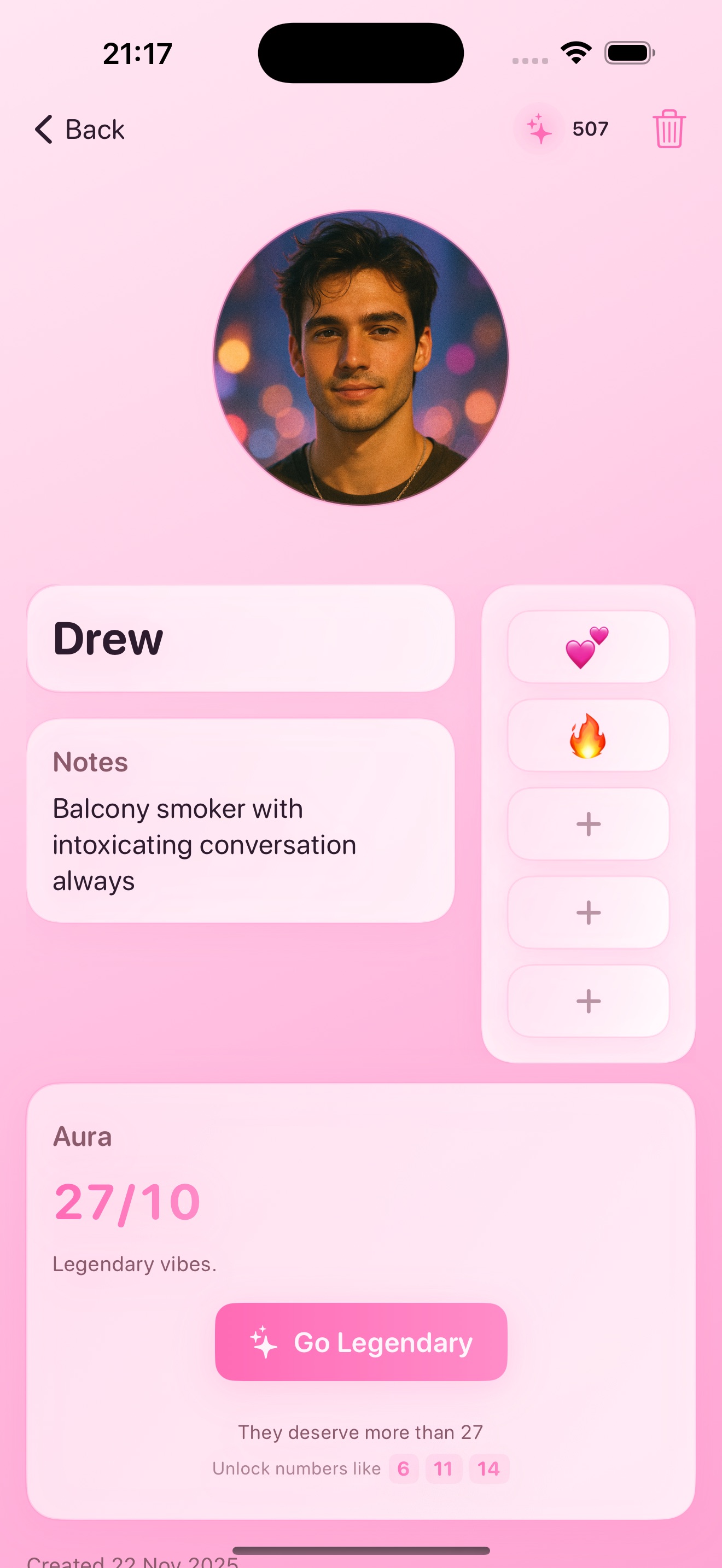
Start simple. Add an entry for someone you've connected with. Include:
- A name or identifier
- An aura score (how did this connection make you feel?)
- Emoji reactions (capture the vibe)
- Private notes (what happened, how you felt, what stood out)
Don't overthink it. Just capture what matters to you.
Step 4: Build the Habit
Tracking is most valuable when you do it consistently. Make it a habit to add entries after dates or meaningful interactions. The more you track, the more patterns you'll see.
Step 5: Review and Reflect
Periodically, look back at your entries. What patterns do you notice? What's working? What isn't? What have you learned?
This reflection is where the real dating journal benefits come from. It's not just about tracking—it's about understanding yourself better.
The Dating Journal Benefits You'll Experience
When you learn how to track dating life properly, you'll start to notice several benefits:
1. Better Decision-Making
When you can see patterns clearly, you make better choices. You recognize red flags earlier. You invest energy in connections that actually work for you. You avoid repeating the same mistakes.
2. Increased Self-Awareness
Tracking helps you understand yourself better. You see your patterns, your preferences, your blind spots. This self-awareness is powerful for personal growth.
3. Emotional Clarity
Processing experiences through tracking helps you gain emotional clarity. You understand why you feel certain ways, what triggers you, and how to manage your reactions better.
4. Reduced Anxiety
When you can see patterns and understand your dating life better, anxiety decreases. You're not flying blind anymore. You have data, insights, and perspective.
5. Honored Experiences
Tracking helps you honor your experiences—both positive and negative. You remember what mattered, what you learned, and how you grew. This creates a sense of continuity and meaning in your dating journey.
Common Questions About Tracking Your Dating Life
Is it wrong to track my dating experiences?
No. Tracking your dating experiences is a tool for self-awareness and personal growth. The key is your intention: are you tracking to understand yourself better, or to judge others? Healthy tracking focuses on self-reflection, not judgment.
Won't tracking make me less present in my relationships?
Not if you do it right. Tracking is something you do after experiences, not during them. It's a tool for reflection, not a distraction from being present. In fact, many people find that tracking helps them be more present because they're not carrying unresolved emotions or confusion into new experiences.
What if someone finds my tracking app?
This is why privacy matters. A good private dating tracker has app lock protection (Face ID, Touch ID, or PIN) so no one can access your entries without your permission. Plus, if your data is stored locally (not on servers), there's nothing to hack or leak.
Should I track every single interaction?
That's up to you. Some people track every meaningful connection. Others only track significant experiences. There's no right or wrong—track what matters to you and what helps you understand your patterns better.
The Bottom Line: Why You Should Track Your Dating Life
Learning how to track dating life privately offers real value:
- You identify patterns and understand what works for you
- You process emotions and experiences in a healthy way
- You remember important details and honor your journey
- You make better choices based on self-awareness
- You grow and evolve with clarity and perspective
The key is doing it safely, privately, and with the right mindset. A private dating tracker that keeps your data on your device, doesn't require accounts, and protects your entries with app lock gives you the safety you need to be honest and reflective.
Friend Aura is designed specifically for this purpose. It's a private connection tracker that helps you track your dating experiences safely, process emotions healthily, and understand patterns clearly—all while keeping everything completely private and secure.
Because your dating life is personal. It should stay that way.
Ready to start tracking? Learn more about the best dating journal app for private relationship tracking, or download Friend Aura and start your private journal today.
Ready to Start Tracking Privately?
Friend Aura is a private dating tracker that keeps your data on your device. No accounts. No servers. No leaks. Just a beautiful, secure space to track your dating life and discover patterns.
Download on App Store